
Scale and spatial organization
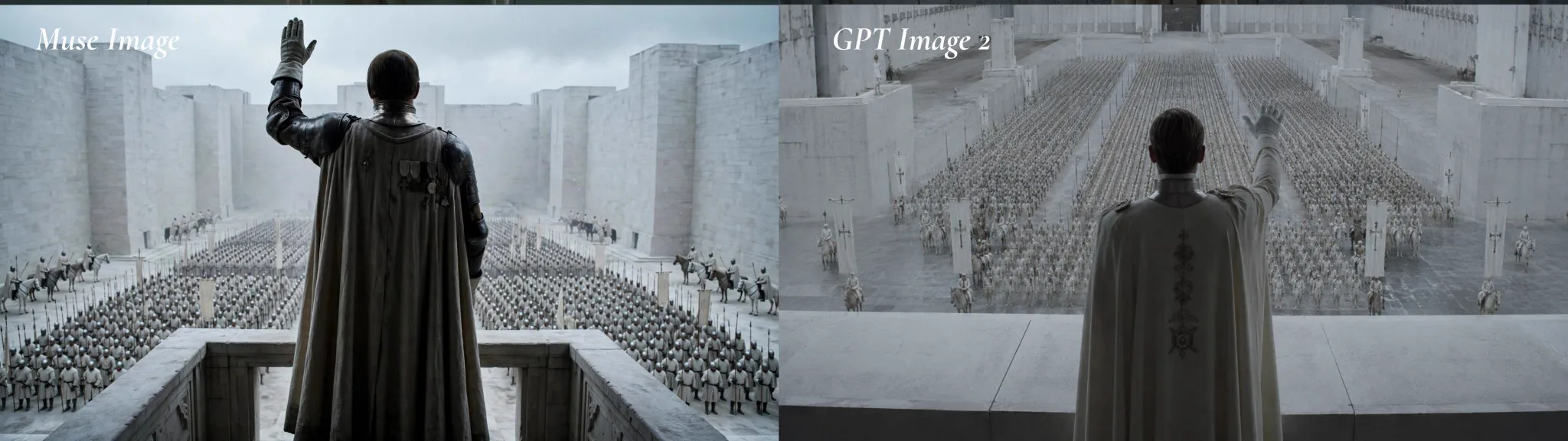
Muse favors monumental symmetry; GPT emphasizes formation depth
AI image model comparison · July 2026
Muse Image brings agentic search, code, self-refinement, and multi-reference composition to Meta AI. GPT Image 2 pairs strong typography and editing with a production API. The better choice depends on where your workflow lives.
See the difference
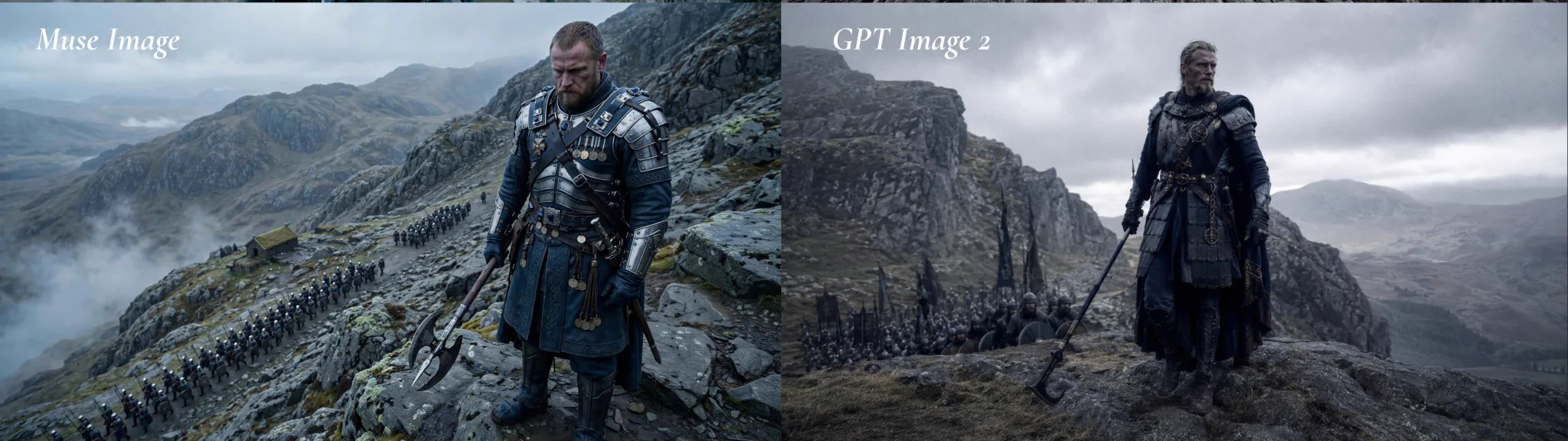
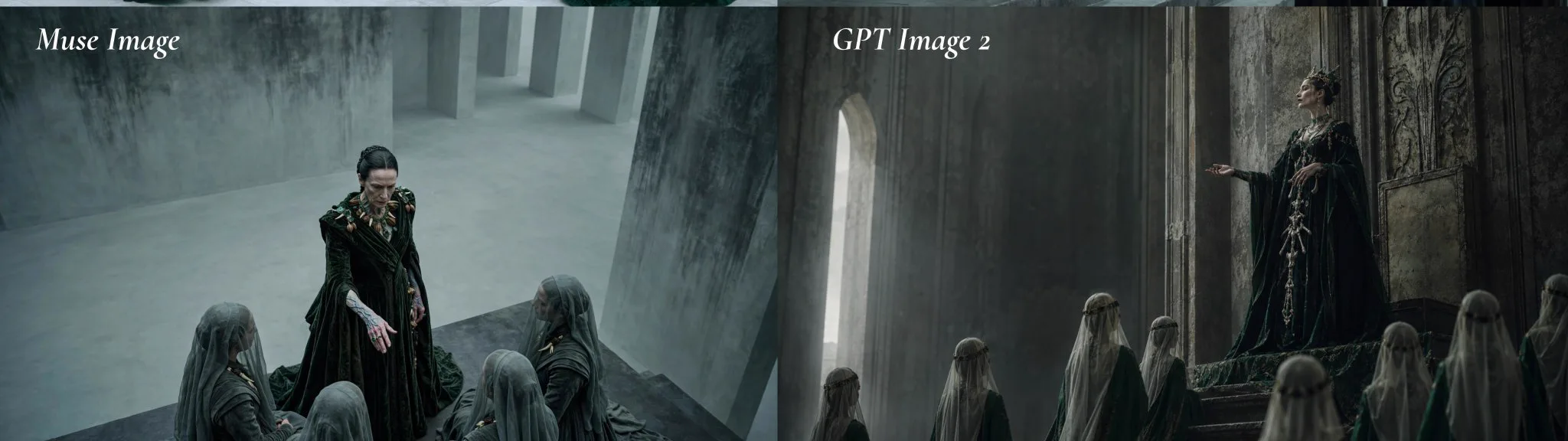
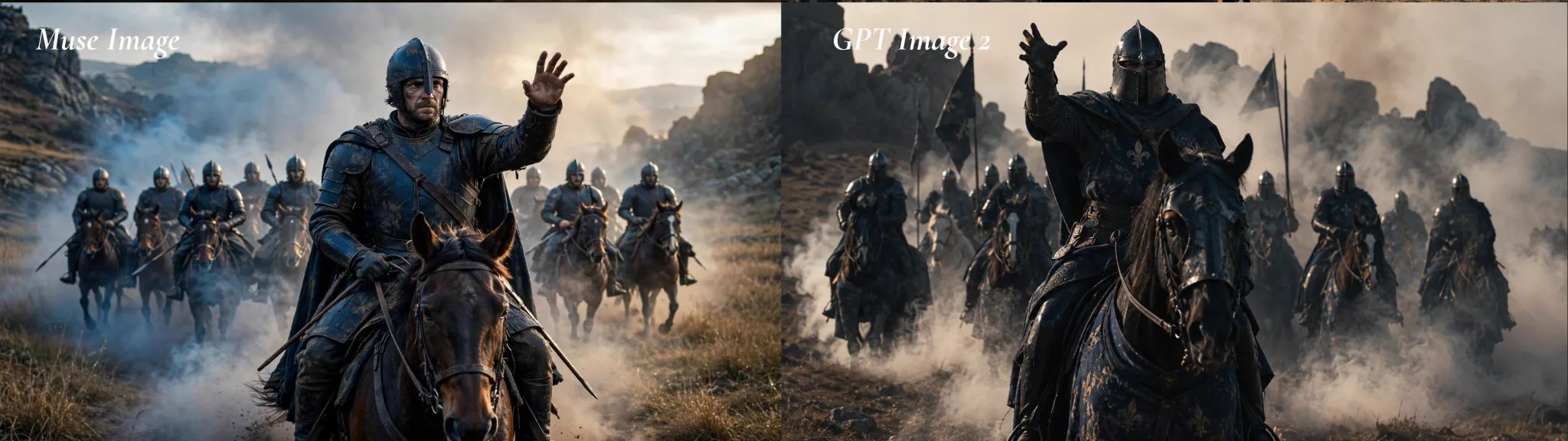
These independent same-brief examples reveal different composition choices. Treat them as workflow evidence, not a controlled laboratory benchmark.
Scale and spatial organization
Cinematic staging
Action and prompt-specific color
A practical editorial scorecard for choosing a model—not a substitute for testing your own prompts.
Complex prompt control
GPT Image 2 is the safer choice when layout, counts, text, and multiple constraints must all survive.
Image editing
Both edit iteratively; GPT adds documented API endpoints and high-fidelity image inputs.
Agentic creation
Muse can search, write code, inspect its draft, and self-refine inside one generation process.
Production workflow
The public GPT Image 2 API makes automation, quality tiers, versioning, and scale easier to operationalize.
Scores synthesize documented capabilities, current product access, and observed output behavior. They are editorial judgments, not vendor benchmarks.
The decisive differences are product access, orchestration, and how each model fits into a repeatable workflow.
| Dimension | Muse Image | GPT Image 2 | Advantage |
|---|---|---|---|
| Current access | Meta AI app and meta.ai; selected Meta surfaces vary by country. | ChatGPT and OpenAI API. | Depends |
| Developer API | No public Muse Image API was announced at launch. | Dedicated gpt-image-2 generation and editing endpoints. | GPT Image 2 |
| Reasoning and tools | Search, code execution, self-refinement, and test-time compute scaling. | Thinking mode can use reasoning, live web search, and multi-image generation. | Depends |
| Editing | Precise conversational editing with coherence across turns. | Conversational editing plus API image-edit support and high-fidelity inputs. | GPT Image 2 |
| Multiple references | Interleaves text and many people, object, clothing, style, and environment references. | Accepts image inputs and supports context-rich iterative generation. | Muse Image |
| Typography and dense information | Strong enough for posters, diagrams, QR codes, and code-rendered figures. | A standout strength across dense text, multilingual layouts, posters, and infographics. | GPT Image 2 |
| Provenance | Content Seal invisible watermark on images created in Meta AI and meta.ai. | C2PA metadata plus an imperceptible content-specific watermark. | Both |
| Best fit | Reference-rich consumer creation and Meta-native social workflows. | Production systems, branded assets, automation, and precise iteration. | Depends |
There is a clear overall production winner, but Muse Image has meaningful workflow advantages of its own.
Muse can search, code, inspect a draft, and refine it as part of the generation process.
Its inline multi-reference design is built for combining people, objects, wardrobe, style, and place.
The consumer experience removes API setup and is available for everyday creation in supported regions.
GPT Image 2 is especially strong for multilingual typography, diagrams, UI concepts, and dense editorial assets.
The OpenAI API supports generation, editing, versioned snapshots, quality choices, and tiered rate limits.
It is easier to standardize prompts, references, edits, and output handling across a team or product.
Match the model to the constraint that would make your project fail—not to a single leaderboard position.
Social concepts and fast exploration
Its Meta AI experience, agentic workflow, and consumer access reduce setup friction.
Product marketing and ad variants
API access and stronger dense-layout reliability make repeatable asset production easier.
Posters, infographics, and UI mockups
Typography and structured information are central strengths of the Images 2.0 release.
Multi-reference moodboards
Meta explicitly designed it to interleave many text and image references in one prompt.
Automated image generation
It is the only one of the pair with a documented public image API at launch.
One-off creative experimentation
Their aesthetic decisions differ enough that the same brief can favor either model.
Not overall. GPT Image 2 is the stronger default for API-driven production, dense typography, and controlled iteration. Muse Image is compelling for agentic creation, multi-reference composition, and low-friction use inside Meta AI.
Yes. Meta says Muse Image performs precise edits, maintains coherence across editing turns, and supports open-ended iterative refinement. Claims that it is only a text-to-image generator are outdated.
Meta had not announced a public Muse Image API as of July 13, 2026. The new Meta Model API preview covers Muse Spark 1.1, which is a different model.
Meta withdrew the feature that let people reference public Instagram accounts after privacy and consent criticism. This comparison therefore does not treat it as an available advantage.
GPT Image 2 is the safer choice for dense or multilingual text, editorial layouts, and infographics. Muse Image can render useful text and can use code for exact charts or QR codes, but GPT Image 2 has the stronger demonstrated typography range.
No. They are independent same-brief examples that make composition differences visible. Use them to form test hypotheses, then run your own prompts, references, edits, and acceptance criteria.
Start from your brief, references, and delivery format—then evaluate the result where it will actually be used.
Explore adjacent model pages and workflows before you lock in a production stack.